

Think of safety glasses as more than just a box to check on a safety list; they are your first and last line of defence in protecting your sight. Proper certified safety glasses are an indispensable piece of personal protective equipment (PPE), engineered to shield your eyes from serious workplace hazards. They are a fundamental tool for preventing life-altering injuries on any job site.
Why Your Choice in Safety Glasses Matters

It’s an all-too-common sight: a worker grabs a cheap, flimsy pair of glasses from the local hardware store, assuming all eye protection is created equal. This is a dangerous misconception.
The reality is that industrial environments—from sprawling construction sites to high-voltage utility work—present complex and severe risks that generic eyewear simply isn't built to handle. Your choice needs to go beyond simply wearing eye protection to selecting the right protection for the specific dangers you face. It’s about understanding the vast difference between a pair designed for light yard work and one engineered to stop a high-velocity projectile.
Moving Beyond Basic Protection
True industrial safety glasses are put through the wringer, rigorously tested to meet stringent standards like Canada's CSA Z94.3. That certification isn't just a sticker on the frame; it's a guarantee that the eyewear has passed demanding tests for impact resistance, optical clarity, and overall durability. Without that assurance, you're just gambling with your vision.
Consider these common workplace scenarios where your average pair of glasses would fail spectacularly:
- High-Velocity Debris: On a construction or manufacturing site, tiny particles from cutting, grinding, or drilling can travel at incredible speeds. Certified safety glasses are built to take that hit.
- Chemical Splash: In labs or industrial cleaning operations, a single splash of a corrosive chemical can cause permanent eye damage. Specialized goggles are designed to create a seal around the eyes, blocking entry.
- Dust and Particulates: Fine dust in workshops or on windy outdoor sites can cause severe irritation and long-term harm. Wraparound frames or foam-lined glasses offer far superior protection.
- Optical Radiation: Welders and even outdoor workers face intense UV and infrared light. Lenses with specific tints and coatings are absolutely essential to filter out this harmful radiation.
Choosing the right safety glasses is an active process of risk assessment. It requires matching the eyewear's specific protective features to the known hazards of your work environment.
The Real Cost of an Eye Injury
Preventable workplace eye injuries are not only devastating for the individual but also carry significant costs for employers. These costs go way beyond the initial medical bills, snowballing into lost productivity, workers' compensation claims, and the potential for long-term disability.
A well-chosen pair of safety glasses is a small investment that pays massive dividends in injury prevention. This guide is your practical roadmap to making informed decisions, whether you're a tradesperson on the tools or a safety manager responsible for outfitting an entire crew. We'll dive into safety ratings, lens technologies, and how to get a perfect fit.
For a broader overview of workplace safety gear, you can also check out our complete guide to safety supplies. Making the right choice ensures you and your team go home safe every single day.
Decoding CSA and ANSI Safety Standards
Trying to make sense of safety standards can feel like you’re reading a foreign language. But when it comes to your eyes, it's the only language that guarantees your glasses will actually do their job when you need them most. Don't think of them as complicated rules; think of them as the official report card for your eye protection. Every little marking stamped on your safety glasses tells a story of intense testing and certified performance.
In North America, two main standards set the bar, making sure your safety glasses are more than just a piece of plastic. Getting to know them means you can confidently pick eyewear that’s truly built for the hazards you face.
The Canadian Gold Standard: CSA Z94.3
If you're working on any job site in Canada, the most important mark to find on your eyewear is CSA Z94.3. This is the benchmark from the Canadian Standards Association for all eye and face protectors, and it's not just a friendly suggestion—it’s a legal requirement baked into many provincial OHS regulations.
When you see CSA Z94.3 on a pair of glasses, it means the whole package—lenses and frame—has survived a gauntlet of tough tests. These tests are designed to mimic the real-world dangers you’d find on a construction site or in a plant.
Key things CSA tests for:
- Impact Resistance: Can the glasses take a hit from a small, fast-moving object without shattering, cracking, or popping out of the frame? This is your defence against flying debris from a grinder or a saw.
- Optical Clarity: Are the lenses crystal clear? They must be free of any distortion that could mess with your vision, give you a headache, or cause an accident.
- Coverage Area: Does the design actually protect your eyes? The standard demands adequate coverage, including on the sides, to shield you from hazards coming from different angles.
Eyewear that carries the CSA Z94.3 stamp offers a proven, reliable defence against the most common eye hazards on Canadian job sites. For any kind of industrial work, it's a non-negotiable.
Understanding ANSI Z87.1 in the United States
Head south of the border, and the standard to know is ANSI/ISEA Z87.1. This is the American National Standards Institute's benchmark and the foundation for eye safety rules across the U.S. The testing is quite similar to CSA's, but the markings are a little different.
The absolute must-have marking on any ANSI-rated glasses is Z87+. That little plus sign is your guarantee of high-impact protection. If a pair is only marked "Z87" (no plus), it's only rated for basic impact and isn't tough enough for environments with flying debris. Always check for the Z87+ on both the lens and the frame.
The seriousness of this standard is reflected in regulations nationwide. For instance, California's workplace safety rules have long required ANSI Z87.1 compliance, demanding that eyewear resist impact, penetration, and heat, and must include side shields for protection from angular hazards. You can dive deeper into California's specific eye and face protection regulations to see how these standards are enforced.
What the Markings Mean on Your Glasses
So, where do you find all this crucial information? Certified safety glasses have these codes permanently stamped or etched right onto them.
- Lenses: Take a close look at the corner of the lenses. You should see the manufacturer's mark, the CSA or ANSI code (like Z87+), and sometimes extra codes for things like UV protection (U) or a specific lens tint (V).
- Frames: Check the temple arms (the "legs" of the glasses) and sometimes the front of the frame. The frame itself has to be marked with Z87+ or the CSA logo for the whole unit to be compliant.
Remember, a high-impact lens sitting in a non-rated, everyday frame is a recipe for failure. The entire assembly has to be certified to work as a system.
For example, our White Goliath® CSA Safety Glasses carry the required CSA markings on both the lenses and the frame, so you know they are fully approved for industrial use in Canada. Once you learn to read these simple codes, you can tell in a second if your eyewear is truly up to the task.
Selecting The Best Lens Materials And Coatings
If the frame is the chassis of your safety glasses, the lens is the engine. It’s where all the critical work happens. The material it’s made from and the coatings applied to it are what stand between your eyes and a worksite hazard, and they determine how clearly you can see while doing your job.
Think of choosing a lens material like picking the right shield for battle. The most common and trusted material across the industry is polycarbonate. This stuff was originally developed for aerospace applications, so you know it’s tough. It’s incredibly lightweight yet offers outstanding impact resistance. Better yet, it naturally blocks over 99% of harmful UV radiation, making it a fantastic all-rounder.
Another top-tier option is Trivex. It’s a bit lighter than polycarbonate and delivers similar impact protection, but its real advantage is superior optical clarity. You’ll often see it at a higher price point, but for workers who need a crisp, distortion-free view for precision tasks, it's a premium choice worth the investment.
Upgrading Your Vision With Lens Coatings
Lens coatings are like performance-enhancing upgrades for your eyewear. These are micro-thin layers applied right onto the lens surface to solve those all-too-common job site frustrations—fogging, scratching, and glare. Each coating is engineered to tackle a specific problem, turning a good pair of glasses into an essential piece of your kit.
Here are the must-have coatings to look for:
- Anti-Scratch (Hard Coat): This is basically a heavy-duty screen protector for your lenses. Polycarbonate is strong, but it's a relatively soft material that can get scuffed up. An anti-scratch coating bonds to the lens, creating a much tougher surface that can handle the daily grind.
- Anti-Fog Coating: Anyone who works in humid conditions or moves between a cold truck and a warm job site knows the struggle. This coating works by absorbing moisture and spreading it into a thin, transparent film, stopping the condensation that instantly clouds your vision.
- UV Protection: While polycarbonate is already great at blocking UV rays, a dedicated UV coating ensures total protection for anyone working outdoors. It’s essential sunscreen for your eyes, protecting them from long-term damage caused by solar radiation.
To make sure your eyewear has been properly tested, it's crucial to understand the standards it's built to meet.
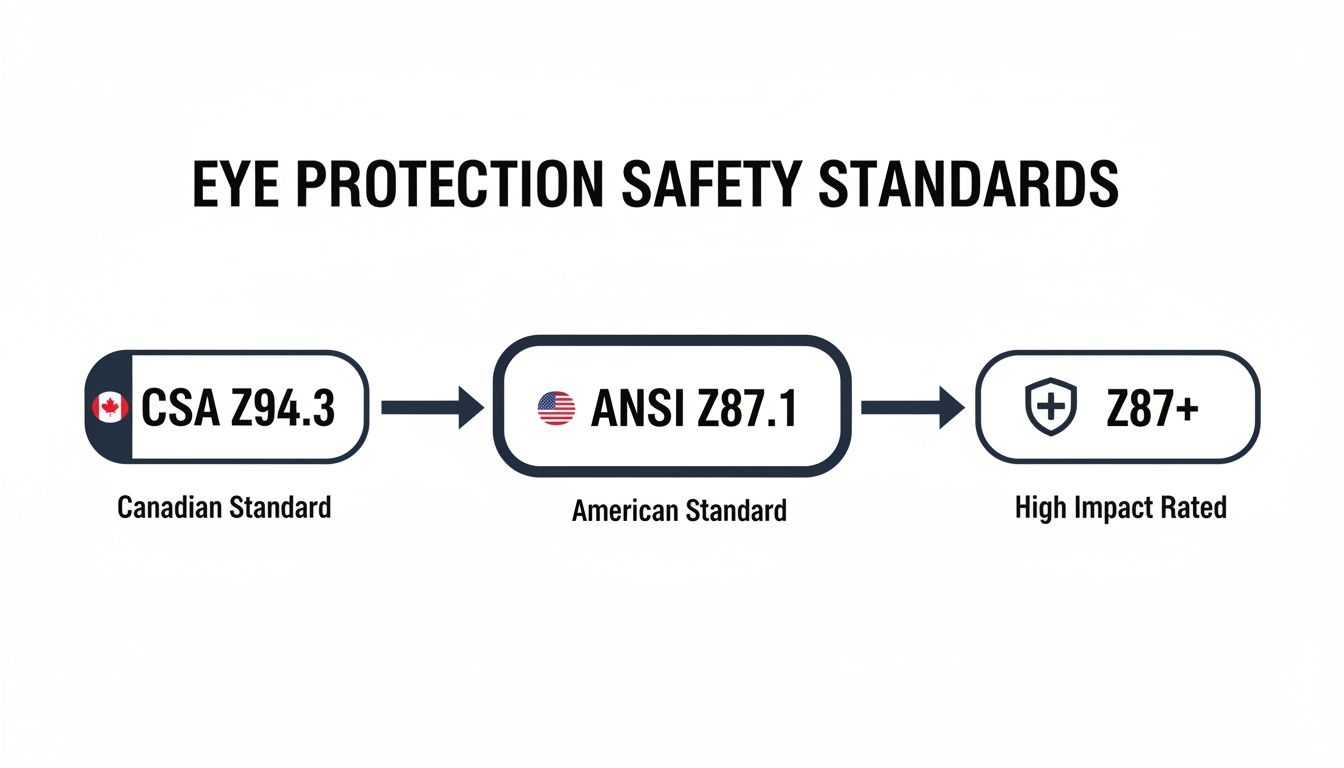
This flowchart shows how Canada's CSA Z94.3 and America's ANSI Z87.1 are the key benchmarks. When you see that Z87+ high-impact rating, you know you're getting robust, reliable protection.
To help you decide, here’s a quick guide to matching materials and coatings to your needs.
Lens Material and Coating Selection Guide
| Feature | Polycarbonate Lens | Trivex Lens | Anti-Scratch Coating | Anti-Fog Coating | UV Protection Coating |
|---|---|---|---|---|---|
| Primary Benefit | High impact resistance | Superior optical clarity | Durability & longevity | Clear vision in humidity | Blocks harmful UV rays |
| Best For | General construction, manufacturing | Detailed inspection, electrical work | Abrasive, dusty environments | High-humidity, temperature changes | Outdoor work, welding sites |
| Key Characteristic | Lightweight and strong | Lightweight and crisp vision | Hardened surface layer | Hydrophilic properties | Filters UVA/UVB radiation |
| Consideration | Can scratch without coating | Higher price point | Essential for polycarbonate | Reapplication may be needed | Standard on most quality lenses |
Choosing the right combination ensures your glasses don't just protect you, but actively help you perform your job better.
Specialized Coatings For Specific Tasks
Beyond the big three, there are specialized coatings that give you a real edge in certain environments. Think of these as fine-tuning your eyewear for peak performance, whether you're under harsh fluorescent lights or out in the blinding sun.
Two of the most popular advanced options are:
- Anti-Reflective (AR) Coating: This coating is a game-changer for minimizing reflections off both the front and back of the lens. If you’re working under bright overhead lighting or find yourself fighting eye strain from glare, an AR coating delivers a much clearer and more comfortable view.
- Mirrored Coating: A common choice for outdoor work in extremely bright, sunny conditions. A mirrored finish does exactly what it sounds like—it reflects intense light away from your eyes, acting like a one-way mirror. This drastically cuts down on squinting and eye fatigue.
The right mix of lens material and coatings isn’t a luxury; it’s a critical part of your PPE. It guarantees your vision stays clear, comfortable, and unobstructed, so you can focus on the task at hand without a second thought.
Getting these features right makes all the difference, especially for those who wear prescription glasses. Finding a solution that works is non-negotiable. Options like the OTS® XL Safety Glasses by Pyramex are specifically designed to fit comfortably over most prescription eyewear, giving you a practical way to get certified protection without compromising your vision. When you take the time to select your lens technology, you’re setting yourself up for clarity and safety, no matter the environment.
How to Find a Perfect and Secure Fit
Even a pair of safety glasses with the highest CSA rating is useless if it doesn't fit right. A poor fit doesn't just feel sloppy; it creates dangerous gaps for hazards to sneak through. It also causes discomfort, which is the number one reason workers take their eye protection off in the first place.
Think of it like a hard hat—if it's loose, it offers very little real protection in an impact. Your safety glasses work the same way. The goal is to get a fit so snug and natural that you forget you're even wearing them. This starts with checking a few key areas to ensure the frame sits correctly on your face.
A proper fit means no uncomfortable pressure points and absolutely no slipping when you look down or move your head. When your eyewear fits right, wearing it becomes second nature.
The Three-Point Fit Check
The secret to a secure, all-day fit is what's known as the "three-point fit." This means your safety glasses should only touch your face in three places: on the bridge of your nose and just behind each ear. This setup distributes the weight evenly and stops the glasses from constantly sliding down.
Here’s a quick checklist to run through when you're trying on a new pair:
- Frame Width: The frames should be just a little wider than your face. The temple arms should extend straight back to your ears without flaring out. If they're bowing outwards, the frame is too narrow for you.
- Temple Arms: The arms need to rest comfortably over your ears. If they dig in or feel like they're too short, they're going to cause headaches and pressure sores over a long shift.
- Lens Position: Your eyes should be centred in the lenses, both from side to side and top to bottom. This gives you the best optical clarity and the widest possible field of protected vision.
A secure fit isn't just about comfort—it's a critical safety feature. Gaps between the frame and your face are open doors for flying debris, dust, and chemical splashes.
Key Features For A Customised Fit
Thankfully, modern safety glasses often come with features designed to adapt to different face shapes, making it easier than ever to nail that perfect three-point fit. Look for adjustability, as it often allows a single style of glasses to work for multiple people on a crew.
A couple of key adjustable features to look for are:
- Adjustable Temple Arms: Some models have arms that you can lengthen, shorten, or even angle up and down. This is incredibly useful for getting the glasses to sit properly when you're wearing other PPE, like the suspension system of a hard hat.
- Soft Nose Pieces: A soft, pliable nose piece does more than just add comfort. It also provides grip, which is a game-changer when you start sweating. This simple feature prevents your glasses from sliding down your nose. Many are made from rubber or silicone for a reliable non-slip fit.
These small details make a massive difference in day-to-day wearability and, most importantly, safety.
Matching Frame Style to Your Needs and PPE
The style of frame you choose also plays a huge role in both fit and function. A wraparound design is one of the most popular choices for industrial work, and for good reason. The lenses curve to follow the natural contour of your face, giving you excellent peripheral coverage and protecting you from hazards coming from the side.
For workers who wear prescription glasses, Over-the-Glass (OTG) models are an essential option. These are built with a deeper and wider frame specifically designed to fit comfortably over your existing eyewear without causing any pressure points.
Finally, always test your safety glasses with all your other required PPE. Put on your hard hat, your respirator, and your hearing protection. Do the temple arms interfere with the earmuffs? Does the brim of the hard hat push the glasses down your nose? Making sure all your gear works together as a complete system is the final step to a truly secure and compliant fit.
By taking the time to select the right fit and style from a wide range of safety glasses, you ensure your protection is never compromised.
Matching Eyewear to Specific Workplace Hazards
Grabbing any old pair of safety glasses off the shelf is a recipe for disaster. While any certified pair offers a basic line of defence, real safety comes from matching your eyewear’s features to the specific, predictable hazards you face every day. The risks on a bustling construction site are worlds apart from those in a chemical plant or on a high-voltage utility line.
Generic protection just gives you generic results. An effective selection process has to start with a deliberate risk assessment. That means taking a hard look at your work environment and picking eyewear engineered to counter those exact threats, leaving no weak spots in your personal protective equipment.
Construction and Manufacturing Hazards
If you work in construction or manufacturing, your eyes are under a constant barrage of high-velocity projectiles. We're talking sawdust, metal filings, concrete dust, and fragments flying off grinding wheels—all of which can cause a severe eye injury in a split second. This kind of environment demands eyewear that puts high-impact resistance and total coverage first.
For these jobs, your checklist needs to include:
- Wraparound Frames: These designs are critical for peripheral protection, shielding your eyes from debris that can sneak in from the sides, top, or bottom.
- Foam Gaskets: In seriously dusty or windy conditions, safety glasses with a removable foam lining are a game-changer. This gasket creates a seal around your eyes, effectively blocking airborne dust and particulates from getting in.
- Anti-Scratch Coatings: A tough hard coat is non-negotiable. Your lenses will inevitably be exposed to abrasive dust, and a quality coating keeps your vision clear and makes your eyewear last longer.
In places with a lot of airborne dust and debris, a standard pair of safety glasses leaves dangerous gaps. Choosing a model with a foam gasket or stepping up to sealed safety goggles is the only way to be sure you have complete protection.
Chemical and Liquid Splash Protection
For anyone in a lab, industrial cleaning, or chemical manufacturing, the main threat isn't impact—it's chemical splash. A single drop of a corrosive substance can cause permanent, irreversible damage. So, the focus here shifts from impact resistance to creating an impenetrable seal.
This is where safety goggles become absolutely essential. Unlike glasses, goggles form a complete seal around your eyes, leaving zero entry points for liquids. You’ll want to look for models with indirect venting; this lets air circulate to reduce fogging without allowing splashes to seep through.
Electrical and Utility Work Challenges
Electricians and utility workers face a unique and incredibly dangerous hazard: arc flash. An arc flash is a violent electrical explosion that unleashes intense heat, a blinding flash of light, and a high-pressure blast. Your standard safety glasses offer zero protection against an event this catastrophic.
Protecting yourself in these roles requires specialized gear:
- Arc-Rated Face Shields: These are mandatory when working on or near energized equipment. The shield must always be worn over your safety glasses to protect against the thermal energy and flying debris from an arc flash.
- UV and IR Filtering: For utility workers spending their days outdoors, lenses that filter out ultraviolet (UV) and infrared (IR) radiation are critical. Polarized safety glasses are especially valuable here because they cut the intense glare reflecting off surfaces like water, snow, or metal, which reduces eye strain and improves clarity.
Many of the principles for selecting workplace eyewear are similar to those used when choosing a guide to eye protection for sports. By carefully assessing your environment and picking the right features, you can make sure your eyewear provides uncompromising safety. Explore our full collection of specialized eye protection to find the perfect fit for your job's unique demands.
Proper Care and Maintenance for Lasting Protection
Your safety glasses are a critical investment in your sight, but their ability to protect you drops significantly without proper care. It's easy to forget, but simply tossing them onto a dusty dashboard or wiping the lenses on a gritty shirt sleeve can cause permanent damage. Those tiny micro-scratches might not seem like a big deal, but they impair your vision and can even compromise the material's integrity over time.
Effective maintenance isn't complicated or time-consuming. It’s really just about building simple, consistent habits. A daily routine for cleaning, storing, and inspecting your eyewear is what ensures it remains a reliable defence against workplace hazards. Think of it as non-negotiable for anyone who depends on their gear to stay safe on the job.
Daily Inspection Checklist
Before every shift, take just 30 seconds to give your safety glasses a quick but thorough once-over. This simple check can reveal critical issues before they have a chance to lead to an injury. Catching a small stress fracture early is exactly what can prevent a catastrophic failure during an impact.
Look closely for these common signs of wear and tear:
- Lens Damage: Check for deep scratches, pitting from sparks or debris, or any chemical clouding that obstructs your vision. Even small distortions can cause eye strain and, more dangerously, hide hazards in your peripheral view.
- Frame Integrity: Examine the frame for any stress fractures, especially around the hinges and the grooves where the lenses are seated.
- Secure Fit: Put them on. Are the temple arms stretched or bent out of shape? The glasses should still provide a snug, secure fit without slipping down your nose when you look down.
- Coating Condition: Look for any peeling or worn-off areas on anti-fog or anti-scratch coatings. If the coating is failing, its performance is reduced, and it's time for a new pair.
Beyond your daily checks, knowing how to clean your glasses correctly is vital. Learn about proper cleaning techniques to ensure crystal-clear vision and eye safety to avoid causing unintentional damage.
Cleaning and Storage Best Practices
Proper cleaning gets rid of grime and sweat without harming those delicate lens coatings. First, always rinse the glasses under lukewarm running water to flush away any abrasive dust and debris that could scratch the surface.
Next, use a designated lens cleaning solution or a single drop of mild dish soap, gently rubbing the lenses with your clean fingers. Finally, dry them with a soft, clean microfiber cloth—never use paper towels or your clothing, as they can be surprisingly abrasive.
Proper storage is your first line of defence against damage. When you're not wearing them, always keep your safety glasses in a protective hard case or a soft microfiber pouch. This shields them from scratches, dust, and getting crushed in a gear bag.
Knowing when to retire a pair of safety glasses is just as important as choosing the right ones in the first place. If you find any significant damage during your daily check—cracked frames, deep lens scratches, a loose fit—replace them immediately. Compromised eyewear is a liability you simply can't afford to take.
Got Questions About Your Safety Glasses? We’ve Got Answers.
Even after you get a handle on the standards, materials, and how to get a good fit, a few practical questions always pop up on the job site. Nailing down the answers to these common queries is key to clearing up any confusion and making sure you’re truly protected.
Let's cut through the noise and get straight to what you need to know. Think of this as your go-to guide for those everyday questions about your safety eyewear.
Can I Just Wear My Prescription Glasses Instead?
Nope. And this is a big one. It's probably the most critical distinction to get right when it comes to eye safety. Your everyday prescription glasses are built to help you see clearly, not to take a hit from a piece of flying debris.
Your regular glasses aren't tested against CSA or ANSI impact standards. If they get struck, they can shatter, turning a potential hazard into a guaranteed eye injury.
So, what are your options if you need vision correction? You've got two solid, safe choices:
- Prescription Safety Glasses: These are the real deal—frames and lenses built from the ground up to meet safety standards, but with your specific prescription ground right into the lenses.
- Over-The-Glass (OTG) Models: These are specially designed safety glasses that are roomy enough to fit comfortably and securely right over your regular prescription eyewear.
Don't ever be tempted to use your standard eyeglasses as a substitute for certified safety eyewear. They just don't have the impact resistance or the side protection needed, leaving your eyes dangerously exposed to whatever the job throws at you.
How Often Should I Replace My Safety Glasses?
There's no hard and fast "best before" date on a pair of safety glasses. Their lifespan really comes down to what kind of work you're doing, how often you're wearing them, and how well you look after them. That said, there are some definite red flags that tell you it's time to retire a pair.
You need to replace your safety glasses immediately if you spot any of these issues:
- The lenses are covered in deep scratches or pits that get in the way of your vision.
- You see any cracks, stress fractures, or other damage on the frame itself.
- The fit has become loose or sloppy because the arms are stretched out or bent.
Even if they look okay, the materials can break down over time from things like UV exposure and just general wear and tear. A good rule of thumb that many safety pros follow is to replace them every one to three years, depending on how rough your work environment is. The best advice? Give them a quick inspection every day. Your eyes will tell you when it’s time for a fresh pair.
At Refinery Work Wear Canada, we stock a full range of CSA-certified safety glasses built for the toughest jobs. Check out our collection and find the right protection for you and your crew at https://canada.refineryworkwear.com.