

When you're trying to figure out your coverall size, your chest measurement is always the best place to start. It’s the single most important number. Standard North American sizes like 40, 42, and 44 are designed to directly match the measurement around the fullest part of your chest in inches.
Use our quick reference table below to get a solid starting point before you dive into more detailed measurements.
Your Quick Reference Coverall Sizing Guide
Let's be honest, whether you're a safety manager outfitting a crew or a worker gearing up for a shift, you need a fast, reliable way to estimate the right size. While a full set of measurements is always best for a perfect fit, the chest measurement is what gets you 90% of the way there.
A coverall that fits properly across the chest and shoulders gives you the room you need to move safely and comfortably. If it's too tight, it's not just uncomfortable—it's a hazard that can restrict your movement when you need it most. This table is your first stop for connecting your chest measurement to a standard coverall size.
Finding Your Initial Fit
Use this table to find the size that lines up with your chest measurement. If you find you're between two sizes, we almost always recommend sizing up. This is especially true if you plan on wearing any layers underneath, which is a given for most of the year here in Canada.
- Step 1: Measure around the fullest part of your chest (we'll show you exactly how in the next section).
- Step 2: Find that number in the "Chest Measurement" column below.
- Step 3: The "Coverall Size" in that row is your starting point.
Quick Reference Coverall Sizing Guide
| Coverall Size | Chest Measurement (Inches) | Chest Measurement (cm) | Typical Fit Recommendation |
|---|---|---|---|
| 38 | 37" - 38" | 94 - 97 cm | Snug fit for a slim build |
| 40 | 39" - 40" | 99 - 102 cm | Standard fit for an average build |
| 42 | 41" - 42" | 104 - 107 cm | Comfortable fit with room for a light layer |
| 44 | 43" - 44" | 109 - 112 cm | Generous fit, suitable for layering |
| 46 | 45" - 46" | 114 - 117 cm | Roomy fit for larger builds or heavy layers |
| 48 | 47" - 48" | 119 - 122 cm | Extra room for maximum layering and mobility |
Key Takeaway: Think of your chest measurement as the foundation of a good fit. Getting this right from the start simplifies everything and dramatically boosts your chances of picking the right size the first time around.
Once you’ve found your starting size here, the next step is to check our detailed measurement guide to confirm your waist and inseam. To see these sizes in action, you can explore our full range of FR coveralls and find the perfect model for your job.
How to Measure for Coveralls Accurately
Getting the fit right starts with getting your measurements right. Taking just a few minutes to measure yourself properly is the single best thing you can do to nail the correct size on your first try, saving you the headache of a return. You'll need a flexible, soft tape measure for this; a stiff metal one from the toolbox just won't bend with your body and will give you wonky numbers.
To get the most precise dimensions, grab some accurate measuring tools and measure yourself over the light base layers or undergarments you’d normally wear on the job. A common mistake is measuring over a bulky hoodie or sweater, which will inflate your numbers and lead to ordering a size that’s way too big.
This simple visual breaks the whole process down into three straightforward steps.
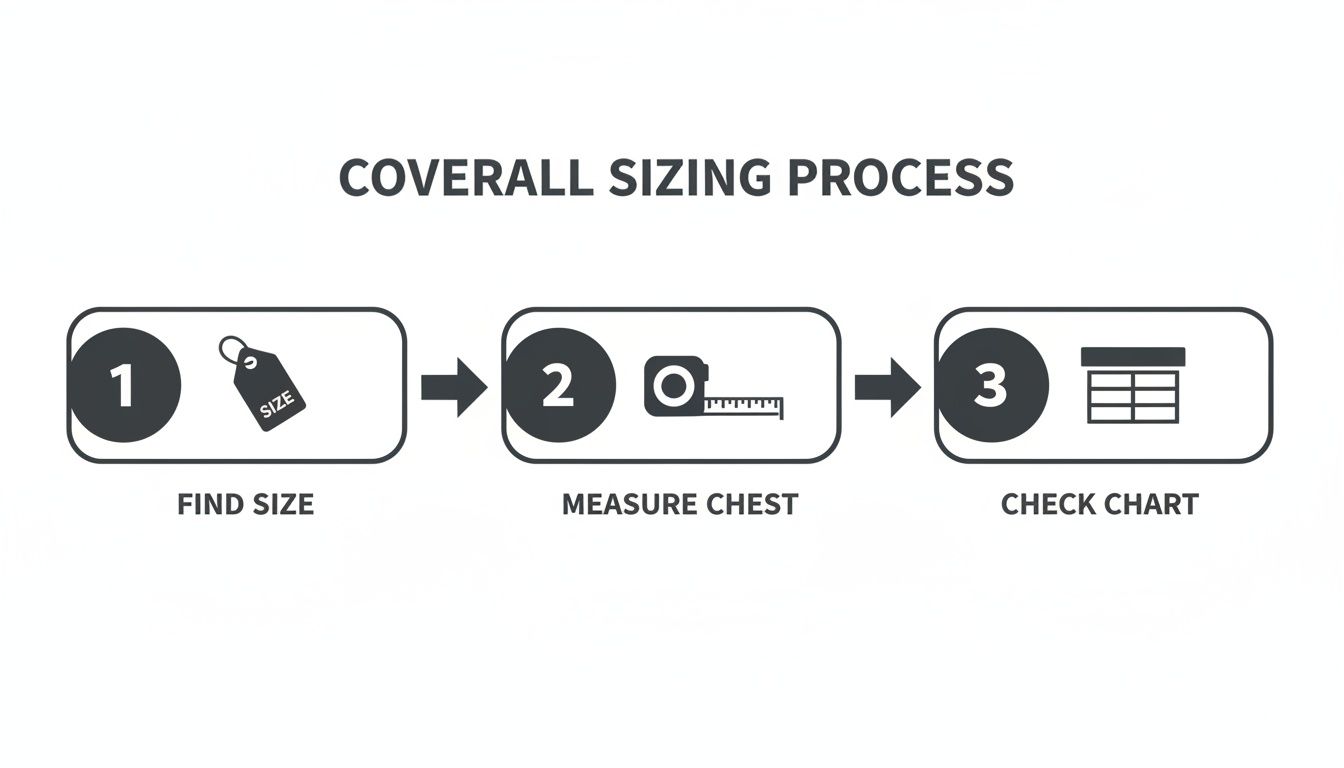
As you can see, the path is clear: figure out your typical size, take a good chest measurement, and then line it up with the coverall size chart.
Key Measurement Points
Follow these quick instructions to get the four critical measurements you need. It’s always a bit easier if you can get a friend to help, but you can definitely do it yourself in front of a mirror.
-
Chest: This is the most important measurement of them all. Wrap the tape measure around the fullest part of your chest, making sure it stays level all the way around your back and under your armpits. The tape should be snug, but not constricting—you should be able to slide one finger underneath it comfortably.
-
Waist: Find your natural waistline, which is usually the narrowest part of your torso, right around your belly button. Stand relaxed and don't suck in your stomach; you want your true, natural measurement.
-
Hips: With your feet together, measure around the absolute fullest part of your hips and seat. Just like with the chest, keeping the tape measure parallel to the floor is key to getting an accurate number.
-
Inseam: Measure from your crotch right down the inside of your leg to your ankle bone. The easiest way to get this one right is to grab a pair of trousers that already fit you perfectly and measure the inseam on them instead.
While most coveralls are sized by the chest measurement, knowing your inseam is especially important for certain styles. For a deep dive into fitting that specific type of gear, head over to our complete guide on how to size bib overalls at https://canada.refineryworkwear.com/blogs/fr-clothing/fr-bib-overalls.
Men's and Women's Coverall Size Charts
Getting the right fit for your coveralls isn't just about comfort—it's a critical safety issue. That’s why relying on a one-size-fits-all approach just doesn't cut it. Unisex sizing often leads to a poor fit that can be baggy in some spots and tight in others, creating snag hazards and restricting movement.
This is exactly why we use separate, dedicated size charts for men and women. Each one is tailored to provide a more accurate, functional, and ultimately safer fit for everyone on the crew.
Men's coveralls are typically sold in numerical sizes (like 38, 40, 42), which is a pretty straightforward system. That number corresponds directly to your chest measurement in inches, giving you an immediate starting point. From there, you just need to pick your inseam length—Short, Regular, or Tall—to match your height.
On the other hand, women's coveralls usually come in alpha sizes (XS-XXL). These aren't just scaled-down men's sizes; they're built using entirely different patterns that account for the natural variations in a woman's chest, waist, and hip measurements. The result is a contoured fit that moves with you, not against you. To see how a proper fit makes all the difference, take a look at our selection of women's FR coveralls.
Understanding Men's Sizing
For men's coveralls, your chest measurement is the key that unlocks the right size. Once you've got that number, you can use a detailed chart to see the corresponding waist and inseam options, making it easy to accommodate a wide range of body types.
It also helps to know what's common in the field. Industry data from Canadian safety reports shows that in the energy sector, a whopping 62% of FR coverall orders were for sizes Large through 2XL. This reflects the powerful builds common in demanding jobs like oilfield work. For example, we see a huge demand for size 46 Bulwark FR coveralls from construction crews in British Columbia, which really drives home the importance of offering a broad size range. You can dig deeper into these industrial sizing insights to see the trends.
We've put together a comprehensive table to help you find your exact fit. Just find your chest measurement and follow the row across to see all the corresponding dimensions.
Men's Standard And FR Coverall Sizing (Imperial & Metric)
| Size (Alpha) | Size (Numeric) | Chest (in) | Chest (cm) | Waist (in) | Regular Inseam (in) | Tall Inseam (in) |
|---|---|---|---|---|---|---|
| S | 36 | 35-36 | 89-91 | 30 | 29 | 31 |
| S | 38 | 37-38 | 94-97 | 32 | 29 | 31 |
| M | 40 | 39-40 | 99-102 | 34 | 30 | 32 |
| M | 42 | 41-42 | 104-107 | 36 | 30 | 32 |
| L | 44 | 43-44 | 109-112 | 38 | 31 | 33 |
| L | 46 | 45-46 | 114-117 | 40 | 31 | 33 |
| XL | 48 | 47-48 | 119-122 | 42 | 31 | 33 |
| XL | 50 | 49-50 | 124-127 | 44 | 31 | 33 |
| 2XL | 52 | 51-52 | 130-132 | 46 | 32 | 34 |
| 2XL | 54 | 53-54 | 135-137 | 48 | 32 | 34 |
| 3XL | 56 | 55-56 | 140-142 | 50 | 32 | 34 |
| 3XL | 58 | 57-58 | 145-147 | 52 | 32 | 34 |
| 4XL | 60 | 59-60 | 150-152 | 54 | 32 | 34 |
| 5XL | 62 | 61-62 | 155-157 | 56 | 32 | 34 |
This chart should cover most standard fits, but remember to always check the specific brand's guide, as slight variations can exist.
Navigating Women's Sizing
Finding the right fit in women's workwear requires a more holistic approach. You really need to consider three key measurements: chest, waist, and hips. Since alpha sizes (S, M, L) are designed to cover a range of body measurements, it’s absolutely essential to see where your specific numbers land on the brand's chart.
A common mistake we see is women simply grabbing a smaller men's size. This almost never works out. The fit is usually all wrong—too tight across the hips, baggy in the shoulders, and dangerously long in the torso, creating a serious snag hazard.
A properly designed women's coverall sidesteps all these issues because it's cut from a pattern made for a woman's frame. This ensures the garment protects you without getting in the way of your movement, which is everything when it comes to staying safe and productive on the job. Always, always start with a size chart built specifically for women's workwear to get the best and safest fit.
Adjusting Coverall Sizing for Winter Layering
Working through a harsh Canadian winter means layering is non-negotiable. But here's the catch: piling on thermal wear, FR hoodies, or insulated vests completely changes how your coveralls fit. A standard-sized coverall stretched over bulky winter gear can get dangerously tight, restricting your movement and even messing with your circulation.

To avoid this, you have to account for that extra bulk when choosing your size. It’s not just about comfort. A snug fit over your winter layers actually compresses the insulation in both your clothing and the coverall itself. This squashes out the trapped air that keeps you warm, reducing the gear's thermal protection and leaving you colder and less safe. The goal is a perfect balance: enough room to move freely without a baggy, hazardous fit that could snag on machinery.
The Rule of Thumb for Sizing Up
The most reliable way to nail your winter fit is to size up from your normal measurements. This gives you the space you need for those underlayers and, just as importantly, that crucial air gap for insulation.
Here are a couple of practical ways to do it:
- Go Up One Full Size: This is the simplest approach. Just choose one full numerical size larger than what our coverall size chart suggests for your base measurements. If you normally wear a size 42, you’d grab a size 44 for winter. Easy.
- Add Inches to Your Chest Measurement: For a more precise fit, add two to four inches (5-10 cm) to your actual chest measurement before looking at the size chart. For instance, if your chest measures 40 inches, you'd use 42" or 44" to find your correct size on the chart.
Choosing the right size for layering isn't just a good idea; it's a proven safety measure. Historical data shows that standardizing FR coverall sizing has significantly cut down on workplace injuries across Canadian oil and gas sites. With up to 85% of workers in cold climates needing insulated gear, proper sizing is critical for preventing hypothermia and ensuring full mobility.
A little foresight here prevents your protective equipment from becoming a hindrance when the temperature plummets. If you're looking to build out an effective cold-weather system, check out our collection of FR winter gear—it features excellent options designed to work together seamlessly.
Solving Common Coverall Fit Problems
Even when you follow a coverall size chart to the letter, fit issues can still creep in. Let's be honest, every body is different, and standard sizing can't always account for unique proportions like a longer torso or broad shoulders. This troubleshooting guide will help you diagnose and solve the most common fit problems, making sure your gear is safe, comfortable, and ready for work.
The first step is always to pinpoint exactly what's wrong. Is your movement restricted when you lift your arms? Does the fabric pull uncomfortably tight across your back when you bend over? Identifying where the fit is failing helps you find the right solution instead of just jumping up to a bigger, baggier size.
Tightness in the Shoulders and Chest
If you feel a distinct pulling across your upper back or chest when reaching forward or overhead, the coverall is too narrow for your frame. This is a classic issue for anyone with broader shoulders or a larger chest than what's considered "standard" for their height.
- Problem: Restricted arm and shoulder mobility.
- Likely Cause: The chest measurement is too small for your build.
- Solution: Go up one full numerical size. For instance, if a size 42 fits your waist perfectly but feels tight in the chest, move up to a size 44. This gives you the necessary room across the upper body without making everything else excessively baggy.
The Crotch is Too Tight
This is one of the most frequent complaints we hear. A tight or high crotch makes bending, squatting, or climbing ladders incredibly uncomfortable and restrictive. This problem is almost always about torso length, not your waist or chest size.
Key Insight: A tight crotch is rarely solved by going up a standard size. This usually just results in a baggier fit everywhere else while the core problem—a short torso length—remains unresolved.
The real fix is to specifically look for a "Tall" (T) or "Long" (L) version of your regular size. These variants are designed with extra length built right into the torso, from the shoulder down to the crotch, giving you the room you need for a full range of motion. So, if a size 44 Regular is tight in the crotch, what you probably need is a 44 Tall.
Overall Bagginess and Snag Hazards
A coverall that's too loose is more than just sloppy—it's a serious safety risk. Excess fabric can easily get caught in machinery, creating a dangerous snag hazard. This issue often pops up when someone sizes up to fix a specific problem, like a tight chest, without thinking about the overall proportions.
Improper sizing is a major safety concern. In fact, research from the Canadian Centre for Occupational Health and Safety (CCOHS) found that 28% of FR coverall-related incidents in certain industrial operations were linked to poor sizing, which increased burn exposure risks. This data spurred the development of better uniform programs that have drastically cut down on misfit issues. You can explore more about these findings on how sizing impacts workplace safety.
If your coveralls are too baggy, you should go back to your base chest measurement and choose a "short" or "regular" inseam to get rid of that extra length in the legs.
Why the Right Fit is a Lifeline in FR Safety
When we talk about Flame-Resistant (FR) workwear, getting the fit right is about so much more than just comfort—it’s a non-negotiable part of your safety system. The entire protective power of an FR coverall is directly linked to how it fits your body. The wrong size can gut the garment's ability to shield you during a thermal event like a flash fire or arc flash.
The performance of FR fabric is dictated by some seriously strict industry standards. If you want to get into the nuts and bolts, our guide to the NFPA 2112 standard is a must-read. Those standards are based on the principle that the garment will work exactly as it did in the lab, and a bad fit throws all that testing out the window.
The Danger of a Tight Fit
A coverall that’s too tight is a recipe for disaster in a few different ways. First off, it stretches the fabric. That tension can thin out the material, potentially weakening its thermal protective performance (TPP). It also puts a huge strain on the seams, which can blow out under pressure and create catastrophic holes in your protective barrier.
Even worse, a snug fit gets rid of the most important safety feature you didn't even know you had: the air gap. That thin layer of air between the fabric and your skin is a critical insulator, slowing down how fast heat can get to your body. Without it, the heat transfer is almost instant, leading to much more severe burns.
The Risk of a Loose Fit
On the flip side, a coverall that’s excessively baggy is just as dangerous, but for different reasons. All that extra material is a major snag hazard, ready to get caught on machinery, tools, or rebar on a job site. This can lead to brutal injuries from falls or, in the worst-case scenario, being pulled into moving equipment.
A baggy garment can also mess with your other Personal Protective Equipment (PPE). Think about a fall arrest harness—if it can't fit snugly and securely against your body because of bunched-up fabric, it might not function correctly when you need it most. The critical role of proper fit extends beyond just the FR garment itself, tying into the whole safety ecosystem. For a broader look, you can find some great context in these general PPE guidelines for hazardous materials.
Critical Safety Insight: That protective air gap is only your ally when the fit is right. If your coveralls are too tight, the gap is gone. If they're too loose, the garment becomes a mechanical hazard. Hitting that perfect middle ground is absolutely essential for your safety.
At the end of the day, using an accurate coverall size chart is the first and most crucial step in making sure your FR gear can do its job. It guarantees you have the room you need to move and work without turning your clothing into another on-site hazard, allowing the life-saving technology in the fabric to perform when seconds count.
Common Questions We Hear About Coverall Sizing
Even with the most detailed size chart in front of you, it’s normal to have a few questions. Getting the right answers is key to making sure you nail the fit on the first try, keeping you safe and comfortable on the job.
Let's dig into some of the most common things people ask us.
Should I Size Up or Down if I am Between Sizes?
If your measurements put you right on the fence between two sizes, the safest bet is almost always to size up. This is especially true when you're talking about workwear.
A little extra room is your best friend for mobility—think bending, stretching, and reaching. A fit that's too snug will pull across your back and shoulders, restricting your movement and putting serious stress on the seams. That extra space is also perfect for layering up in colder weather without feeling constricted.
Do Coveralls Shrink After Washing?
Yes, you can expect some shrinkage, particularly with coveralls made from 100% cotton. Most quality workwear manufacturers build this into their sizing, but a 3-5% shrinkage after the first few washes is pretty standard.
The best way to keep it to a minimum is to follow the washing and drying instructions on the garment's tag to the letter. Sizing up, like we just talked about, also gives you a nice buffer against any minor shrinkage that does happen.
How Does a Tall Size Differ from a Regular Size?
This is a big one. A "Tall" or "Long" size isn't just about adding a few inches to the pant legs. The most critical difference is the extra length added to the torso—that crucial measurement from the base of your neck down to the crotch.
This is what solves that common, uncomfortable problem of the crotch riding up every time you bend over or squat. If you have a longer-than-average torso, a tall size is absolutely essential for a proper, non-restrictive fit, even if the leg inseam on a regular size looks right on paper.
Still have questions? The experts at Refinery Work Wear Canada are ready to help you find the perfect fit for your entire crew. Explore our full collection and contact us for personalized sizing assistance.